• Skip to primary navigation
  • Skip to main content
  • Skip to footer
Interface

Interface

  • about
  • collaborators
  • aesthetics
  • technology
  • transplants
  • Blog

Popular Culture

Drag Face: exploring my identity through masculine performance

January 21, 2021 by Fay

Drag Face: exploring my identity through masculine performance

The Author

Isabel Adomakoh Young
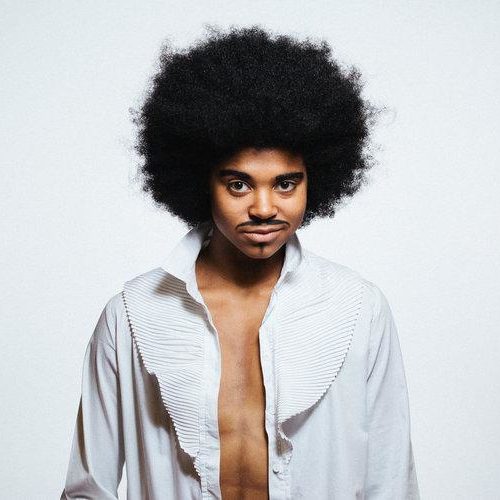
Isabel Adomakoh Young discusses identity, race, and performing as a drag king in this week’s guest blog. Don’t miss our other blogs exploring the connections between faces, expression and identity: Daring to be Different, by Amanda Bates and Owning by Face, by Marc Crank.

Drag Face: exploring my identity through masculine performance

As a young woman in the final years of her Bachelor’s degree, I had a complex relationship with my face already. It’s well known by now that women are under an onslaught of marketing and socio-historical pressure to take issue with our natural appearance. Young women, only just getting to know themselves and how they interact with the world around them, are susceptible to this in specific ways. 

Then there was the fact of my being one of a handful of brown faces across the entire university – “the beans in the rice”, as an African American man I once met put it. I was lucky enough, however, to have been raised with priorities beyond surface appearance, and with a sense that I was both Ghanaian (father’s side) and English (mother’s), rather than neither. I was also lucky that my appearance passed for ‘normal’ in all the insidious ways that make some people’s lives easier and some people’s incredibly hard.

I appeared confident enough to my peers, apparently, to be invited to perform in theatre shows, which I did with some trepidation and a lot of enjoyment, until one day I was asked, quite out of the blue as it seemed to me, if I wanted to come to a drag workshop. An actor I knew a bit had cooked up the idea with a director to get a group of women together and explore ‘drag kinging’. It was the first time I’d heard the phrase and it took me a moment to understand. Drag queens are historically men exploring femininity, so… kings must be women exploring masculinity! It makes perfect sense when you think of it, but I certainly never had. 

As the years have gone by since, I learned that not many people have, even now. (The binary concept of swapping opposites has also been exploded by the fantastic variety of drag performance I’ve since encountered, across the gender spectrum. But that was all still to come.) And they’d chosen me, for reasons I was never clear on, as someone who ‘might be interested’. I was.
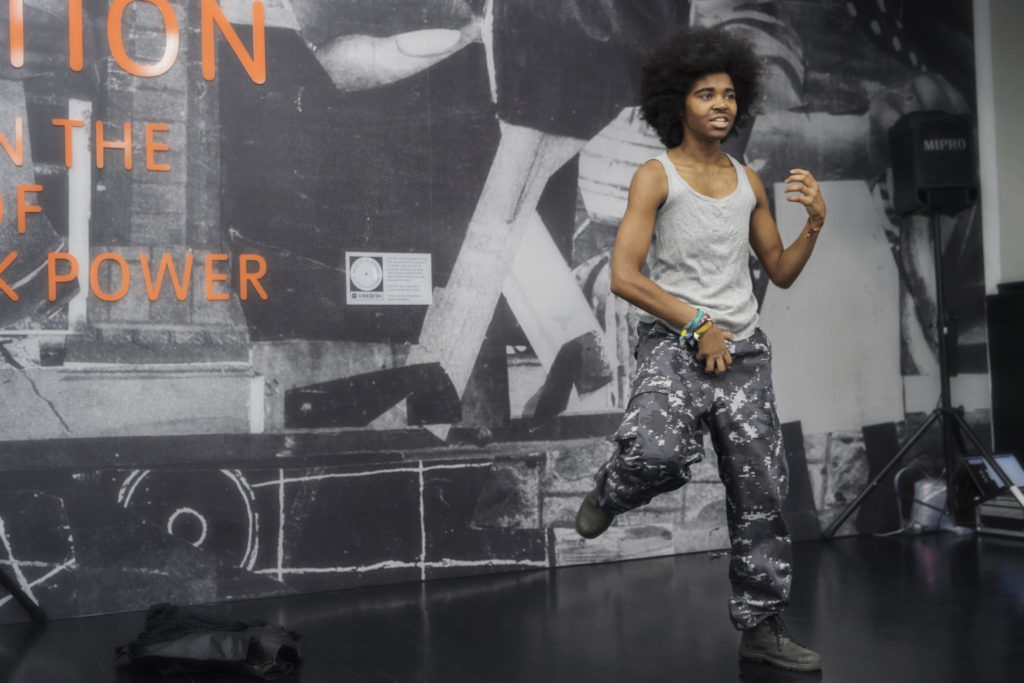
Image credit: Alex Wojcik

A group of us met in a big college space they’d booked, with carpeted floor and wraparound windows. The two directors did a little presentation; some quotes from gender theorists, images of music hall performers, 80s musicians, smoky cabaret shows, boy bands. Gradually, we moved from discussion to action, pulling on miscellaneous pieces of clothing people had brought, watching the lines of our bodies alter. We asked, what makes a man? What do we do that most men don’t? How would you signify masculinity without words? What might your body do in public space? Alone? What is male seduction like? What about men who don’t read as conventionally masculine? It was fascinating. 

I suddenly became aware how hard I worked, almost unconsciously, to signify femininity to those around me. Decisions I’d made years ago, as a pre-teen, about “what a woman does”, how my face rests or moves, where and how my body should be. Weight on one leg, give way on the pavement, lively smile not slack neutrality. Attractiveness, passiveness, correctness. I’d grown out of ideas like putting your tongue in your back teeth when you smile, or perfecting the America’s Next Top Model “smize”, but there were stealthier, less conscious things still in there. Feminist activism had highlighted oppressive norms to me by then, but not down to my own physicality. 

I realised then that I could let go of some of those behaviours; the ones that I’d chosen not from a place of authenticity but of fear and shame, the ones that didn’t express me.

Not many of the group knew each other, but we leaned in close, sharing eyebrow pencils and contour brushes in what would become a familiar routine, but was, that first time, revolutionary for us. With the scanty internet guidance we could find, and lots of discussion, we re-invented ourselves. Moustaches and beards, sure, but subtler things too. Of course each man is different, but how to signal masculinity to an audience? Might eyebrows be heavier, might an adam’s apple protrude more, a jawline be more square? The art of contouring; many of us were well-practised in traditionally feminine makeup, but now we were in uncharted waters, our old habits useless. It was exciting. I followed along with the group’s decisions, only later recognising that a broad rule for Caucasian men may not be right for a mixed-race king.
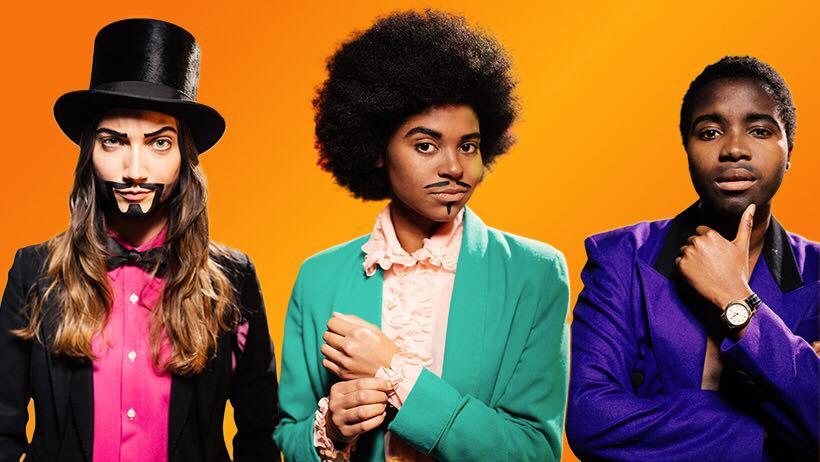
Image credit: Stephen Allwright

We laughed as students walked unwittingly past the huge windows, thrilled to be in these new unfamiliar guises. Looking into a hand-mirror, I saw someone known and unknown, like a long-lost brother. As a child, I’d been a tom-boy for years, wishing in some nebulous way to “be a boy”. What if that kid could see me now? I even found my face moved differently; my new character raised one eyebrow suggestively, hooded his eyes and held a sleepy half-smile. He pleased an imagined audience without trying. Where did this all come from?

As we explored the theory of drag more – discussing performative gender, preconceptions and limitations, norms and expectations – the fact that masculinity really is seen as the default was brought home to me. Part of what was so liberating about drag kinging was that we were breaking free of the age-old principle that a man is a blank slate, full of potential and possibility, but a woman is a set thing, constrained; a thing to get right or wrong. 

When we’d formed our company Pecs Drag Kings, and told people about it, we often met blank looks, questions like “But what do you even do?” etc. It takes some thought to realise that masculinity is just as performative as femininity. Just because men mostly don’t paint their faces these days doesn’t mean the concept’s not hugely contrived. Our fun, high energy, surprising cabaret shows bring that truth into focus in technicolour.
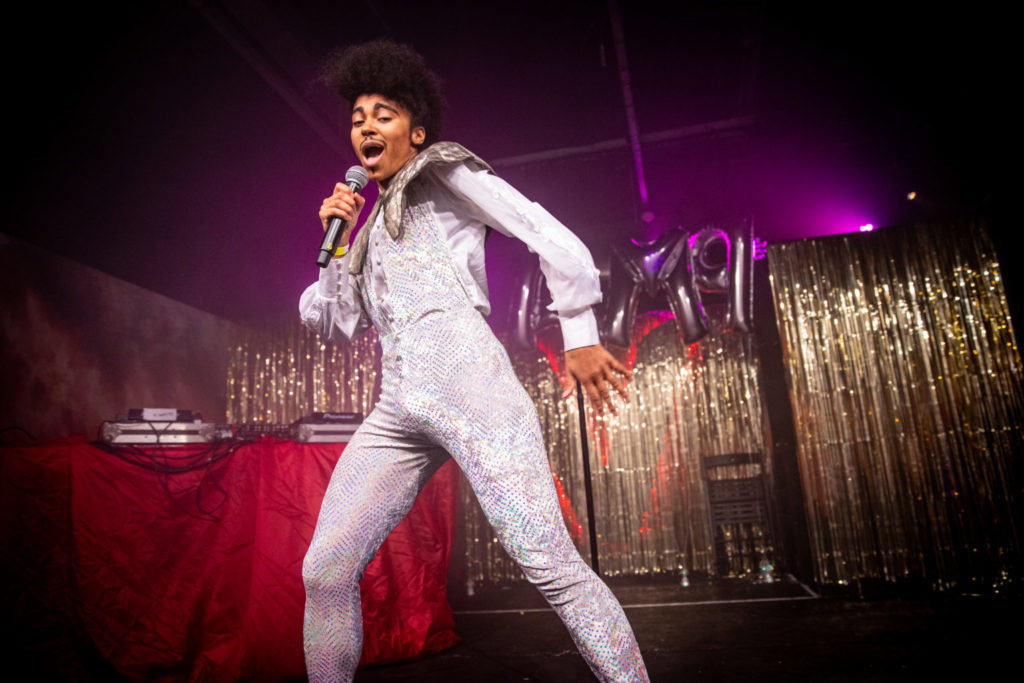
Image credit: Harry Elletson

While I’m proud of the brilliant work Pecs make, and the fascinating conversations it sparks – which I love eavesdropping on in the bar after the show – I am most grateful to drag for helping me to find my own gender expression. By pushing boundaries and exploring possibilities, I’ve found a more authentic version of my day-to-day self; in my appearance and in how I move through the world. I set the terms of my gender expression now, each and every day. I’m glad that through our workshops and shows we sow those seeds in others too.

Author Bio

Isabel is a queer theatre-maker, voiceover and writer of English and Ghanaian origins based in London. After studying English at Cambridge, she trained with NYT Rep, then joined the Royal Shakespeare Company for 2019. She co-created the binary-bending collective Pecs Drag Kings, inclusive arts event Brainchild Festival and the bestselling ‘Lionboy’ book trilogy, adapted and toured globally by Complicité.

http://www.isabeladomakohyoung.com/

Further reading

view all

[carousel_slide id=’329′]

Filed Under: faces, guest blog, Popular Culture

Visualising Evil: Depictions of Visible Facial Difference in Film Culture

May 7, 2020 by Fay

Visualising Evil: Depictions of Visible Facial Difference in Film Culture

The Author

Dr Sarah Hall

Facial scarring has long been used in the film industry to imply evil or villainy. In this blog, Dr Sarah Hall (University of York) explores the damaging effects of this outdated trope.

Visualising Evil: Depictions of Visible Facial Difference in Film Culture

At a pivotal moment in Star Wars: The Rise of Skywalker, the antagonist of the sequel trilogy, Kylo Ren, is healed of the facial scar that he received in The Force Awakens. That scar, which had mysteriously moved across Ren’s face by the time that The Last Jedi was released, was inflicted after the antagonist committed his darkest act in that film. That the scar healed as Ren was brought back to the light side was no afterthought. The appearance and disappearance of the scar represented Ren’s character progression from troubled, to unquestionably, abhorrently and violently evil, and back to redemption.

Visual Clues

It is a familiar trope. There is a long history of popular film culture relying on facial difference, particularly scarring, to denote villainy. Viewers are inundated with visual references to remind us of the immorality of the antagonists that occupy our screens, and the final Star Wars instalment continued to cement the narrative that a wounded face is a signifier of evil. To really bring the point home, we should perhaps remind ourselves that Ren’s redemption story failed to offer up any real reasoning for his change of heart, only that he was moved by protagonist Rey’s decision to heal him. The scar, then, becomes a primary signifier of his redemption. Not only is it a visual clue for the viewer, but its removal forms an emotional foundation for change from bad to good, dark side to light.

Star Wars is set in a galaxy full of archetypes. Good and evil form the balance on which numerous characters teeter in all three trilogies. However, this familiar simplicity should not prevent us from questioning why popular film repeatedly returns to this tired trope.

Scarring and James Bond

I am new to the AboutFace project. I will admit to not having thought critically about this issue in any depth until recently. It is something that I’ve had a background awareness of, I think you’d be hard-pressed to find someone that isn’t, but I’ve been afforded the privilege of not being directly impacted by these issues. Since joining AboutFace in March, I have been thinking about faces, facial difference, facial injury, surgery and their representations more than I ever thought I would. All of a sudden, the presence of villains with facial scarring became excruciatingly apparent. My timing was perhaps partly to blame.

After seeing a trailer for the new Bond film, No Time to Die, I decided to tackle my entrenched dislike of the Bond franchise and watch all of the Daniel Craig films before the release of the latest instalment, which was due in April but has been pushed back to November due to the Covid-19 pandemic. I was surprised. I did enjoy the films, but they also made me uncomfortable.

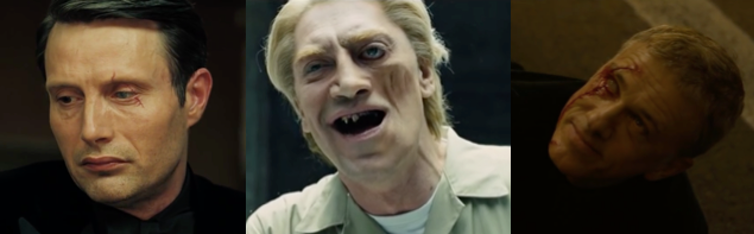
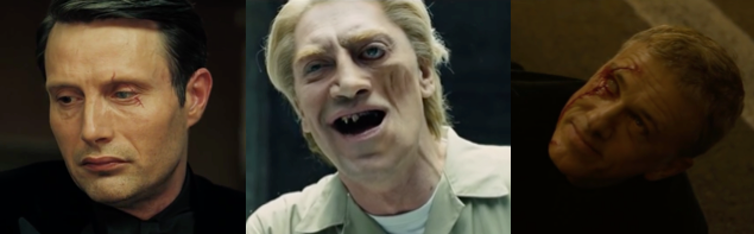
The Bond series is especially wedded to the trope that scars, burns, and other facial injuries signify evil. Even if you just take the recent releases, you can’t help but notice the trend: Mads Mikkelsen’s La Chiffre in Casino Royale; Javier Bardem’s Raoul Silva in Skyfall; Christoph Waltz’s Blofeld in Spectre (back for a second instalment in No Time to Die); and if one scarred villain wasn’t enough for No Time to Die, Rami Malek has also joined the cast to play a terrorist leader with an injured face, partially covered by a mask. That two facially scarred villains were written into a single film might suggest that the 25th Bond instalment may not, as hailed, be the ‘most woke yet.’ It might be fair to say that Bond films are not known for their subtlety or nuance, but these are villains played by talented actors whose abilities need not be augmented by visual scarring. Why, then, do producers continue to rely on this trope?

Credit: MGM/Columbia Pictures

The face, identity and history

The history of this association goes back further than you might imagine. Beauty ideals have long contributed to the notion that beauty equates with goodness and ugliness with evil, stemming from the classical world. While beauty ideals may have shifted over time, there is a consistent connection between the face and identity. In the early modern period, the face also carried deeper suggestions of honour, and severe facial difference or injury often carried dehumanising associations. The connection between villainy and facial scarring or difference is not new, it was not invented by film companies, though it has become their bread and butter.

These cultural and emotional histories have also been influential in contemporary medical intervention. It has been suggested that negative responses to facial difference could have emerged from a cognitive threat detection mechanism. Health professionals working on the human face, whether in psychology, dermatology or surgery, have drawn connections between disgust and facial disfigurement. Perhaps, then, producers and writers in the film industry are just playing on recognised human responses? But the argument that disgust is somehow an evolutionary response does not take into account the fact that disgust sensitivities are far from static throughout history, that ‘disgust’ is subjective, dynamic, and emotionally and culturally influenced. Is it not time to give current cinema audiences the credit that they might be able to work out which character is the villain without facial scarring?

A ‘historical document’?

In an article for The New Yorker, David Owen wrote that over time, the body becomes ‘a kind of historical document.’ Dramatic moments are memorialised in scar tissue. It rings true for scars in film. Scars can be illustrations of a traumatic incident that either marks the point of descent into evil, as with Kylo Ren, or they might signify a past event in a character’s life that has contributed their villainous state. Suggesting stormy lives, filled with pain or violence, think Heath Ledger’s Joker in The Dark Knight, scars are visual clues to a villain’s (sometimes complex) backstory. All too often, however, the scar is little more than a device to make a character appear more sinister, as with the surprisingly superficial Isabel Maru played by Elena Anaya in Wonder Woman (2017). I say surprisingly, because the film was so widely praised for its progressive outlook. The suggestion in this case is that Maru is evil from the outside in.

But while there may sometimes be a rationale for choosing to give facial scars to on-screen villains, this does not negate the significant negative stereotypes that can be associated with visible facial difference as a result. In a video produced by the Guardian, the notion that scars are representative of past trauma is reinforced. However, the speakers remind us of some of the painful reactions people have had to their scars. Whether the scarring serves to reveal the hidden depths of a villain to the audience, or if it solely serves as a visual clue for evil, the association strengthens the notion that a visible facial difference marks the bearer as unfamiliar to many audience members, defining them as ‘other.’

#IAmNotYourVillain

UK charity Changing Faces sought to challenge this tired trope in 2018 and have continued fighting for change on our screens ever since with their #IAmNotYourVillain campaign. Their call for action followed numerous studies that highlighted the negative association between visible facial difference and villainy on-screen. The charity’s CEO, Becky Hewitt, told the Guardian that young people don’t tend to make the association between facial difference and negative traits until they are exposed to popular media representations. This would suggest that the prejudice is learned, and possibly at a young age.

AboutFace hopes to contribute to the efforts set in motion by Changing Faces, challenging prejudice and misconception as part of our research, which will explore cultural systems of conformity, beauty and facial perfection in the age of the selfie both through academic research and public engagement events. Our Lived Experience Advisory Panel supports us in this work. Their involvement at key milestones in the project will ensure the research is relevant and meaningful to those to whom it matters the most.

Representation

Misrepresentation can be incredibly damaging, but so can a lack of representation. Changing Faces has called not only for fewer negative depictions of facial difference, but an increase in positive representations. They encourage the diversification of occasions of facial difference in film, moving away from the most prevalent villainy or vulnerability. The reasons for this have been powerfully articulated by some of the charity’s champions, such as Tulsi Vagjiani, a plane crash survivor who told the Telegraph that she was compared to Freddy Kreuger when she was growing up. The makeup used to transform actor Robert Englund into the notorious horror villain was based on medical photographs of burn victims, directly connecting real scarring to the demonic Kreuger.

The BFI quickly moved to support the Changing Faces campaign in November 2018, making the decision not to fund films in which the villain has scars, marks and burns. Speaking about the decision, deputy CEO Ben Roberts referred to the criteria in the BFI diversity standards, which call for meaningful representations on screen. In 2019, the BFI helped to fund Dirty God, a film about a woman trying to reclaim her life after an acid attack, starring burn survivor Vicky Knight. The film has been hailed as a strong positive representation and has also had a positive transformative effect on Knight’s own outlook.

This might be new ground for film, but it doesn’t appear to be the herald of a new era. While high-budget, high-profile films like No Time to Die, continue to dominate, can we hope to see any meaningful change in the cinematic representation of visible facial difference? The AboutFace project is seeking to explore the social context in which facial transplantation happens. In doing so, we are drawing attention to the social pressures to look a certain way. This theme of the scarred villain is part of our broader discussions of difference in societies fixated by visual appearance.

Author bio

Dr Sarah Hall is Associate Lecturer in Public History at the University of York. She was previously Public Engagement and Events Officer on AboutFace.

Further reading

view all

[carousel_slide id=’329′]

Filed Under: facial injury, facial surgery, film, hollywood, human rights, Popular Culture, Visible Facial Difference

  • « Go to Previous Page
  • Go to page 1
  • Go to page 2
  • Go to page 3

Footer

logo logo

interface@kcl.ac.uk

Privacy policy

 ©Interface 2023